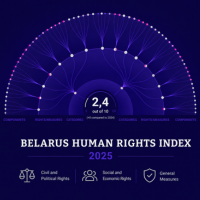
The Belarus Human Rights Index 2025 has been published.
As a reminder, the Index compares Belarus with itself over time, tracking changes in the full spectrum of human rights from year to year.
Spoiler: For the first time in seven years, the overall Index score has not declined compared to the previous year. However, this does not mean that the human rights situation has stabilized. Rather, it reflects the effect of approaching the lower limit of the scale.
About the Index
The Belarus Human Rights Index is an annual assessment of the human rights situation in Belarus. Since 2019, it has been prepared by a group of experts from Belarusian civil society under the overall coordination of the Belarusian Helsinki Committee. More than 35 experts contributed to the 2025 Index.
The Index provides an overall assessment of the human rights situation as well as a breakdown across three categories: Social and Economic Rights, Civil and Political Rights, and General Human Rights Measures. It evaluates specific rights, their components, and indicators of compliance with an ideal human rights situation.
The assessment is based on 290 quantitative indicators scored on a 10-point scale, each accompanied by expert commentary.
We created this Index for three reasons:
- to allow interested professionals to quickly assess the overall human rights situation in Belarus rather than gathering information from scattered sources;
- to demonstrate how the situation is evolving from year to year;
- to indicate the direction of human rights reforms that Belarus needs.
In 2024, the Human Rights Index was featured in the Annual Report of the United Nations High Commissioner for Human Rights as an important tool for assessing the compliance of national laws, policies and practices with international human rights standards.
2025 Results
The overall Index score remained 2.4 out of 10 in 2025, unchanged from 2024.
For the first time in seven years, the overall Index score has not declined compared to the previous year. The Index fell by 1.0 point in both 2019 and 2020, by 0.4 points in 2021, 0.2 points in 2022, and 0.1 points in both 2023 and 2024. However, this does not mean that the human rights situation has stabilized. Rather, it reflects the effect of approaching the lower limit of the scale.
The number of indicators receiving the absolute minimum score (1 out of 10) has increased almost sixfold — from 6 indicators in 2019 to 37 in 2025.
Expert commentary points to the deepening of repressive practices and the continued shrinking of the space for exercising even the most fundamental human rights.
The scores declined for five rights:
- the right to life;
- freedom of thought, conscience and religion;
- the right to education;
- the right to social security;
- the right to participate in cultural life.
The sharpest decline in 2025 was recorded in the area of cultural rights. The indicator measuring non-discriminatory access to cultural life fell by 0.5 points, the largest single decrease across the entire Index. The right to education declined evenly across all five of its components, indicating not an isolated setback but a systemic erosion.
While the overall scores for the remaining rights formally remained unchanged, 98 of the 290 indicators within them declined. Because the Index uses average scores, the overall score for a right may remain unchanged even if a third of its components have deteriorated.
Each year, the Index records a small number of improvements in individual indicators — typically between three and fifteen. In 2025, there were five, including expanded HPV vaccination coverage and new measures to strengthen the right to work for persons with disabilities. However, none of these improvements was sufficient to increase the overall score of the corresponding right.
Some violations affect several rights simultaneously. For example, the forced expulsion from Belarus of pardoned political prisoners in 2025 negatively affected indicators related to the right to life, the right not to be subjected to torture, the right to liberty and security of person, the right to a fair trial, and the right to participate in cultural life.
The full Index data and expert commentaries are available on our website.
What Comes Next
In the coming weeks, the Belarusian Helsinki Committee will share additional findings from the Index, highlighting specific figures and less obvious connections between different human rights.
Supported by
The Index is published with the support of the Kingdom of the Netherlands (Human Rights Fund), the European Union, and the Global Initiative Against Impunity (GIAI). Its content reflects the views of the authors only and does not necessarily represent the official position of the Kingdom of the Netherlands, the European Union or GIAI.